On Wednesday, the Johnson County Board of Supervisors got a presentation from Shive-Hattery on the updated plan for a new, $96,000,000 jail and sheriff’s office. On Thursday, the Board of Supervisors entered into a purchase agreement for land, which wasn’t provided to the public in advance, that they on begrudgingly admitted was for the $96,000,000 jail and sheriff’s office. On Friday, Johnson County Deserves Better launched in opposition to what is expected to be an ask of the voters this November for $96,000,000 to pay for this new jail and sheriff’s office.
What follows, and the art on this post, is from that campaign, and posted in its entirety in solidarity.
Johnson County is hurtling towards a nearly $100,000,000 investment in a brand-new, bigger jail. If approved, it will be one of the largest locally funded public investments in Johnson County in memory, yet there is still so much we don’t know – and still many unanswered questions – about the plan.
Johnson County deserves better
What we do know is troubling.
Johnson County voters have routinely rejected building new, bigger jails – five times since 1976 – decisions that have saved us money both by avoiding the construction of a costly single-purpose building and by forcing our local criminal punishment infrastructure to find alternatives to expensive detention and incarceration. We know that this time, however, instead of engaging the broader community about what a solution should look like, the planning committee at the start involved only County Sheriff Brad Kunkel, the Sheriff’s Department’s command staff, Johnson County’s facilities manager, and County Attorney Rachel Zimmermann Smith, which has delivered a plan that is simply the Sheriff’s wishlist.
We know this project is wildly more expensive than the $10.5 to $15 million it was estimated, by Johnson County’s engineering consultant in 2024, that it would cost to rebuild the existing jail at its current size. The Johnson County Board of Supervisors wants to borrow $96 million, paid off over 10 years through increased property taxes, to build a new jail that would allow the incarceration of almost double the current population — going from 65 to 120 with eventual expansion to imprisoning 240 people — all while Johnson County’s incarceration rate has declined.
We know any extra jail capacity will be commandeered by ICE and put our vulnerable immigrant neighbors at risk. And we know local law enforcement is already collaborating with ICE, because state law gives us no other choice.
We know that racism is baked into the criminal punishment system, even in Johnson County, where Black people are booked into the jail at about five times the rate of white people.
We know that Johnson County’s jail population has trended downward — look at the numbers from the Sheriff’s Department itself — and we know that there is more we can do to encourage this trend with jail diversion and other community-focused programs. Lower incarceration rates are a good thing. And despite our self-identity as a forward-thinking community willing to invest in prevention and diversion, we are still behind neighbors like Linn County, which invested in mental health reentry resources when state funding was eliminated.
Johnson County deserves honesty and transparency
While Johnson County leaders have made many claims about why it’s necessary to build an expensive, new, larger jail, there are precious few facts to support their claims.
We’ve been told the jail has reached the end of its life, yet the local engineering firm hired to assess the building’s structure wrote unequivocally, “Axiom Consultants would not state, at this time, that the building is in danger of imminent structural failures of any sort,” and noted that, due to its construction, the building “is durable and resistant to age related damage in ways many other buildings aren’t.”
Certainly there has been a long policy of deferred maintenance of the building. Sheriff Kunkel will point to cosmetic issues of stained ceiling tiles, chipped wall paint, and cracks in the brick facade as his proof. But is this proof the taxpayers should bear a $100 million burden? Beyond the recently completed roof and exterior work, repairs to the building were estimated at less than $2 million by engineering consultants in 2024 — just 2 percent of the planned bond request.
And the Johnson County Jail isn’t even dirty; the State Jail Inspector wrote in his 2025 report, “the Johnson County Jail is the cleanest that I have observed.”
Johnson County deserves facts
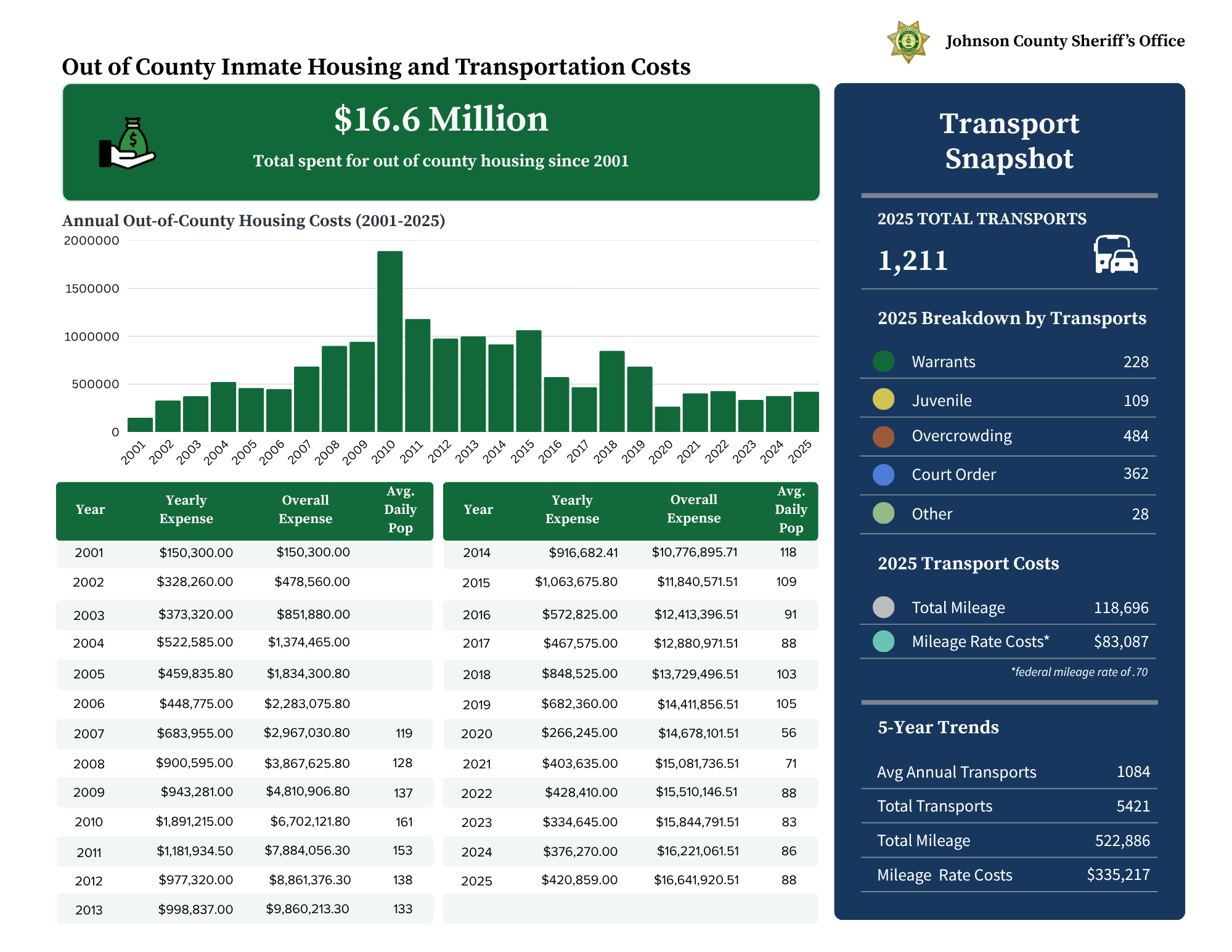
We’ve been told that building a new, larger, nearly $100 million jail will save taxpayer money by eliminating the need to transport people to other counties and paying to incarcerate them there. However, according to the data from the Sheriff’s Department, out of 1,211 people transported out of county in 2025, fewer than half were moved due to overcrowding. Even still, in 25 years, Johnson County has paid less than $650,000 a year to transport and detainpeople in other counties — at that rate it would take about 150 years to spend what this new jail plan will cost.
The claimed savings rely heavily on it costing less per day to incarcerate people in Johnson County than elsewhere, yet this claim isn’t substantiated. While it costs $50 to $120 per person per day to incarcerate someone in another county’s jail, the Johnson County Sheriff’s Department has not been willing or able to quantify what the cost per person per day will be in the new jail nor has it been forthcoming with the current daily cost per person in the existing jail. How are Johnson County taxpayers to believe that it will actually cost less per day to keep people here in a new jail, before we even begin to factor in the nearly $100 million in capital cost, when we don’t even have the facts about current costs?
We’ve been told the condition of the current jail is inhumane, but there is nothing to indicate the Sheriff’s Department would prioritize human dignity in a new jail. Being incarcerated locally in Johnson County doesn’t even increase incarcerated people’s access to their families. The Sheriff’s Department currently refuses to allow in-person visitation, forcing families to use costly video calls through a third-party for-profit company rather than allowing them to sit in the same room together with their loved ones. The new jail plans don’t seem to allow human contact like on-site visiting areas, let alone allow for basic human needs — according to the schematic designs, incarcerated people will have no access to, or even direct views of, the outside world.
We agree the current jail is inhumane, but a new jail won’t solve the existing problems. The deaths in the Johnson County Jail under Sheriff Kunkel’s watch were not because of conditions in the building; they were due to poor policy and staff disregard for the human beings under their care.
The proposed new jail would have more capacity for people who need treatment for mental illness than either the current jail or Guidelink Center. However, jails are not where we should treat mental illness.
Johnson County deserves answers
Voters and community members still don’t know exactly what we’re being asked to fund, how much it will really cost to build, how much it will cost to operate, or the answers to 96 million other questions.
Johnson County deserves disclosure of the true costs and transparency about the true reasoning behind these “needed” plans.
The burden of proof is on Sheriff Kunkel, County Attorney Zimmermann Smith, and Supervisors Jon Green, Lisa Green-Douglass, and outgoing Rod Sullivan, who often use the word “need” when discussing a new jail and the wishlist put forward by the Sheriff’s Department. These leaders haven’t definitively shown why we need a new place to hold virtual-reality training, or need to a new place to park Johnson County’s military surplus mine-resistant ambush-protected (MRAP) vehicle, or need to build private offices and K9 kennels larger than the cells for incarcerated people.
For something Johnson County leaders have been trying to sell us for years, there should be more answers. Or at least some answers. Johnson County voters shouldn’t be asked to take any of this on faith. When trust in government is at an all-time low, Johnson County government officials should be expected to show their work.
Johnson County deserves investments aligning with our priorities
This spring, voters soundly rejected pro-jail Board of Supervisors incumbents and candidates in favor of jail-skeptical ones — Johnson County leaders should stop and listen to the people they serve.
We imagine there are better ways to spend nearly $100 million.
We imagine ending homelessness in Johnson County, not a jail. We imagine funding childcare so parents can work and care providers can make a good wage, not a jail. We imagine community investments tripling those seen from the American Rescue Plan Act, which had a transformational impact on Johnson County and its cities, not a jail. We imagine providing real mental healthcare in the community and in schools and in libraries, not a jail. We imagine making sure our neighbors are no longer hungry, not a jail. We imagine building crisis response infrastructure that acts before there are victims and doesn’t rely on incarceration, not a jail. We imagine being creative and trying something new. Not another jail.
We’re voting “no” to spending $96,000,000 for a new jail on Nov. 3 because Johnson County deserves better.